I walked out of my own rehearsal dinner holding forty pages and a gold pen I hadn't meant to take.
Nobody stopped me.
I think they assumed I was going to the restroom to cry and fix my mascara, the way girls who marry up are supposed to.
The woman was already outside.
She stood under the one sodium light at the far end of the yacht club lot, next to a dented gray hatchback with a Los Angeles dealer frame on the plate. The light turned everything orange. Her raincoat. Her dark hair. The cigarette she wasn't smoking, only holding.
Behind me, through the glass, the string trio started up again.
"You brought them," she said. "Good."
"Who are you?"
She dropped the cigarette into a cup of cold coffee on the hood of her car.
"Audrey Whitcomb. Tyler's sister. The one cut out of the boat photo in the upstairs hallway, with half a face and one shoulder."
I knew the photo.
It hung in the upstairs hallway in La Jolla. Tyler at maybe ten, on a boat with his parents. A girl's arm and shoulder and half a squinting face at the crooked left edge, where someone had cut the print.
I had asked him once whose arm it was.
He'd said, "My sister. We don't really talk about her," and changed the subject to dinner.
"You're the arm," I said.
"I'm the arm." She held out her hand for the prenup. "The family stopped mentioning me nine years ago. I'm a forensic accountant now, which my mother would call poetic if she were capable of irony."
"How did you know about tonight?"
"My aunt can't keep a secret if it's on fire. She called me last week and said Celeste was having the lawyer draw up something special for you." Audrey's mouth went flat. "When my mother has a lawyer draw up something special, someone ends up paying for it."
I handed her the pages.
My hands were still shaking. I noticed it the way I'd notice a tremor in a patient, from somewhere outside myself.
She didn't start at the front.
She flipped straight past the property schedules and the boilerplate about separate accounts, past Tyler's neat blue initials in the corner of every page, past the date at the top that said three weeks ago.
She stopped at page thirty-one.
"Here," she said. "This is the one Philip Ostrander always hides."
"Who?"
"The family attorney. The man in the tan suit at table one, eating his second crab cake." She tilted the page toward the light. "He's been burying things in definitions since before you were born. Nobody reads definitions."
She read it out loud.
Her voice was flat and clear, like a pharmacist reading back a dose.
"'For purposes of this Agreement, Shared Household Obligations shall include, without limitation, any obligation of any enterprise in which either party, or any member of either party's immediate family, holds a beneficial interest, including the Whitcomb Marine floor-plan credit facility set forth in Exhibit F, for which each Spouse shall be jointly and severally liable as a personal guarantor.'"
I stared at her.
"I don't know what half of that means."
"I know." She turned to the back of the document and found Exhibit F. It was one page. A table with a bank logo pasted at the top.
Harbor Coast Bank.
Floor-plan line of credit. Borrower: Whitcomb Marine, LLC.
Commitment amount: $4,200,000.
"Floor plan is how dealerships buy inventory," Audrey said. "The bank pays for the boats. The dealer sells the boats and pays the bank back. It's a revolving line, and it's huge, and when it goes bad, it goes bad fast."
"Why is it in my prenup?"
"Because if you sign this, you become a personal guarantor on that line." She tapped the words with one finger. "Jointly and severally. That means the bank doesn't have to chase the business first, or Tyler, or my mother. It can come straight to you for every cent."
"I don't own any part of the dealership."
"Read page twelve. You're specifically excluded from any ownership interest. Forever. Even if you divorce." She almost laughed. "You'd hold the debt with none of the asset. It's elegant, honestly. I'd admire it if it weren't you."
I thought about my paychecks.
I make $108,000 a year working nights in the ICU at the county hospital. It sounds like a lot until you know about the five years of overtime it took to pay off $62,000 in nursing school loans. One shift at a time. Christmas mornings. Fourth of July. The night my grandmother died, because I couldn't afford to call out.
I had made my last loan payment in January.
I had screenshotted the zero balance and sent it to my mother, and she had called me crying.
"What happens," I said, "if the dealership can't pay?"
"Then the bank garnishes your wages. Liens your car. Takes your savings. Follows your future earnings until four point two million is paid back or you file for bankruptcy." Audrey closed the document. "And a bankruptcy shows up on background checks. Including the ones hospitals run."
The sodium light buzzed above us.
A gull walked across the lot like it owned it.
"Is the dealership failing?" I asked.
Audrey looked at me for a long moment.
"My mother just tried to make a stranger personally liable for her credit line in front of sixty witnesses so nobody could say you were pressured in private," she said. "What do you think?"
My throat closed.
"Tyler initialed every page."
"I saw."
"It's dated three weeks ago. We had dinner with my mom three weeks ago. He picked the restaurant. He held my hand the whole time."
Audrey didn't say anything kind.
I was grateful for that. If she had, I would have fallen apart in a parking lot in a dress my mother would be paying off for a year.
"Don't sign it," she said instead. "Don't argue with her either. She wants a scene. Scenes are where she wins."
"So what do I do?"
"Go back in. Say you need time to have it reviewed. Say it calmly. Then leave."
"That's it?"
"That's everything. She can't do anything with a woman who's polite and busy."
I went back in.
The trio was halfway through something soft. The waiters were clearing salad plates. Somebody laughed at table four, and then saw me in the doorway, and stopped.
I walked the long way around the room so I could pass my mother.
Rosa Delgado had both hands flat on the tablecloth. Her lipstick was perfect. Her eyes were wet and furious.
I touched her shoulder once as I went by.
She covered my hand with hers for half a second and let go.
Celeste was still standing at the head table.
She had been talking to Philip Ostrander, leaning down with one hand on the back of his chair. When she saw me, she straightened and smiled with all her teeth.
"There she is," she said, loud enough for the whole room. "Ready?"
Tyler was in the same chair.
He still wasn't looking at me. He was looking at his water glass like it held instructions.
I set the gold pen down on the white tablecloth.
Very carefully. Cap on. Pointed away from me.
"Thank you, Celeste," I said. "This is a very detailed document. I'm going to have it reviewed by my own attorney before I sign anything."
The trio kept playing for two more bars.
Then the cellist noticed and stopped, and the other two stopped with him, and the room went completely quiet.
I could hear the ice settling in sixty glasses.
Celeste's smile didn't move. Only her eyes did, down to the prenup in my hand and back up.
"Sweetheart," she said, "there's nothing to review. It's standard."
"Then it won't take long."
"The wedding is Saturday."
"I know when my wedding is."
Somebody's fork hit a plate.
Philip Ostrander set down his crab cake and wiped his fingers on his napkin, one at a time.
"Ms. Delgado," he said, in a voice like warm butter, "I drafted that agreement myself. I assure you it's entirely customary for families with business interests."
"Then you won't mind someone else reading page thirty-one."
His napkin stopped moving.
It was the smallest thing. A half-second pause. But I have spent six years watching people's faces when they lie about how much pain they're in, and I know what a half-second pause looks like.
Celeste held out her hand, palm up.
"Leave the document, dear. That's the family's copy."
"It has my name on it," I said. "I'll keep it."
I turned around and walked out.
Nobody clapped. Nobody spoke. I heard my own heels on the hardwood the whole way to the door, every single step, like a heart monitor.
Tyler caught up with me at the bottom of the front steps.
"Maya. Maya, wait."
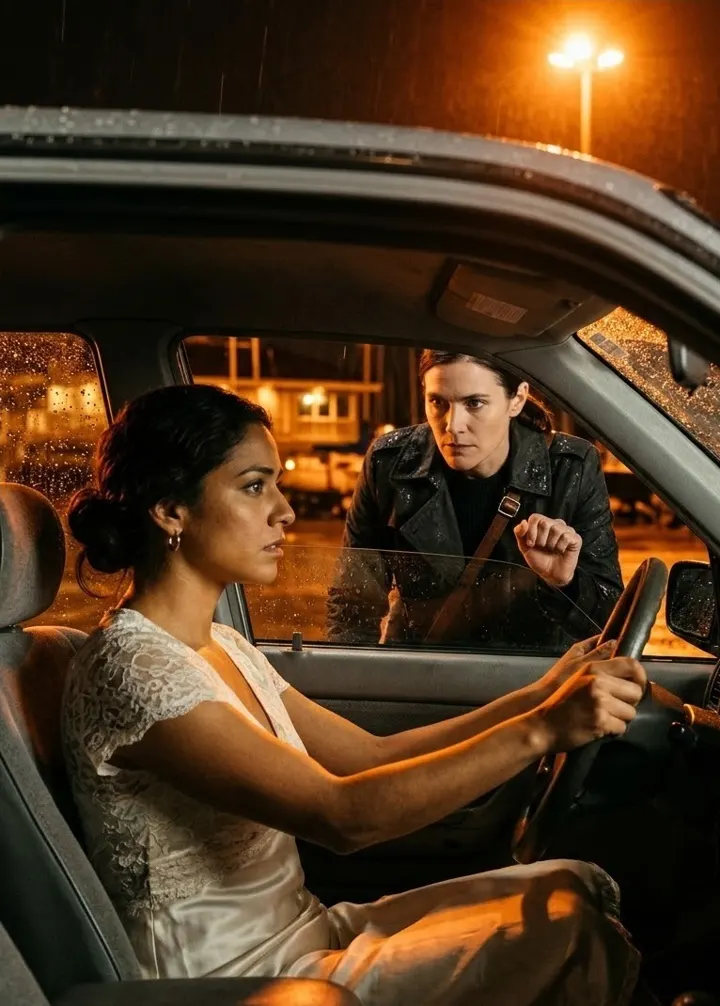
I stopped beside my car. A ten-year-old silver sedan, parked between a white convertible and a black SUV with dealer plates from Whitcomb Marine.
"Talk to me," he said. "Please. Just talk to me."
"You talk to me." I held up the prenup. "Your initials are on every page."
He rubbed his face with both hands.
"It's just paperwork. Mom handles the paper stuff. You know how she is."
"Did you read it?"
"I mean, I looked at it."
"Did you read page thirty-one?"
He opened his mouth. Closed it. Looked back up the steps at the glowing windows, where I could see the shapes of people standing up to watch us.
"Can we just talk about this tomorrow?" he said. "After everybody calms down? She's embarrassed, Maya. You embarrassed her."
I waited for more.
For him to say he was sorry. Or that he didn't know. Or that he'd tear the thing up in front of her himself.
He said, "Come back inside. Just for dessert. It'll look bad if you leave."
I got in my car.
I was still in the dress. Ivory silk with a lace overlay my mother had picked out, the one she called "the rehearsal dress" like every bride needs two. The skirt bunched against the steering wheel. I didn't care.
Tyler stood on the curb with his hands in his pockets while I started the engine.
Then he went back up the steps.
He went back inside.
I sat there with the engine running and my hands at ten and two, the way my father taught me in the church parking lot when I was fifteen. I breathed in for four. Out for four. The way I coach patients off a panic before a central line.
Someone knocked on the passenger window.
I jumped.
Audrey stood there in her raincoat, orange under the light, rain starting to spot her shoulders. She made a rolling motion with one finger.
I lowered the window halfway.
She leaned down so we were eye level.
"One more question," she said. "Then I'll let you go."
Before I pulled out, Audrey tapped my window and asked, "Did anyone pull your credit back in March? Because somebody pulled mine the year I turned twenty-two."