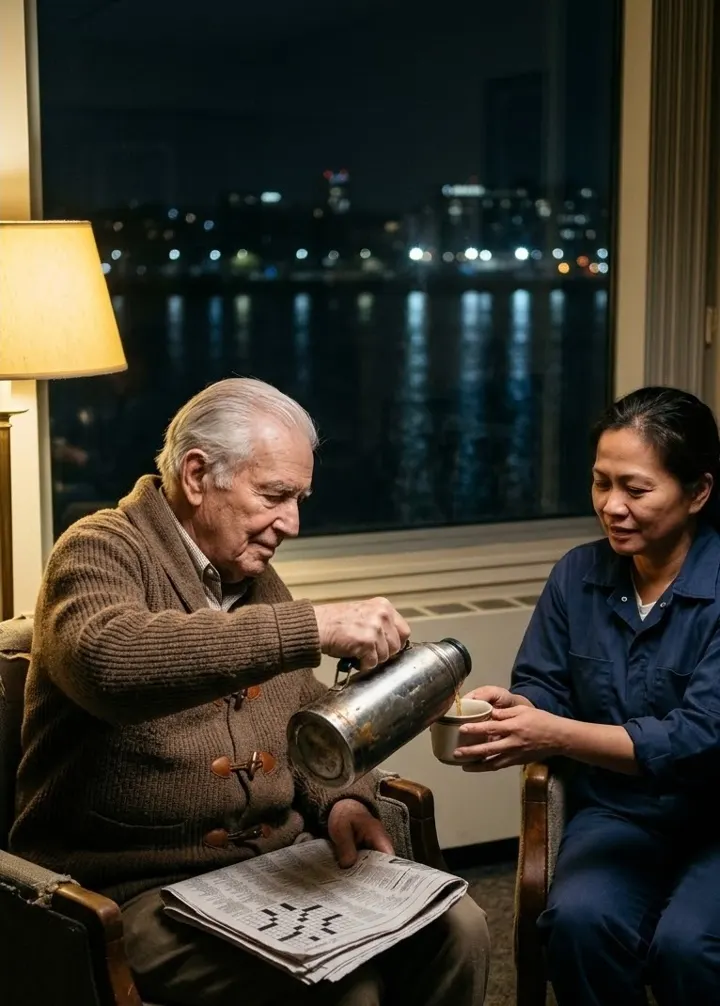
The first time I met Art, I thought he was lost.
It was two years ago in October, almost to the week. I was on my break, which I always took on the twelfth floor because the property management office there had a little lounge with a window facing the river, and nobody used it at night.
Except that night, somebody was in my chair.
An old man in a brown cardigan with leather buttons. Thin white hair combed straight back. A newspaper folded into quarters on his knee, a pencil behind his ear, and a dented steel thermos on the floor by his shoe.
"Oh," I said. "Sorry."
"Is this your seat?" he asked. He had a slight accent I couldn't place, the edges of the words a little rounded.
"It's nobody's seat. I just usually sit there."
He stood up, slowly, the way older men stand when their knees have opinions. "Then it's yours."
"You don't have to..."
"I've been sitting for three hours. It will do me good to stand." He nodded at the thermos. "Do you like cardamom? I always make too much."
I didn't know what cardamom was. I said yes anyway.
That was how it started.
He said his name was Art. He said he "looked after the building," which I took to mean he was some kind of retired engineer they kept on to watch the boilers, the way some buildings do. He had big hands with swollen knuckles, a scar across one thumb, and he knew things about the Halden nobody else knew. Which elevator stuck in cold weather. Why the 19th floor always smelled like oranges. (A juice company, in the eighties. The smell got into the ductwork and never left.)
He came in most nights around midnight and left before the morning crew. I asked him once why he worked such terrible hours.
"I don't sleep anymore," he said. "My wife died in July. The house is very loud when nobody's in it."
Her name was Margit. They were married forty-six years. She painted watercolors of birds and could not cook at all, and he did every meal for almost five decades and never minded.
I told him about Ramon. How he walked steel on high-rises, how he used to say the view from forty floors up was the only thing he owned outright. How he fell from a scaffold on a Tuesday when Jolie was thirteen, and how the company's lawyers had found a way to make it mostly his fault.
Art didn't say he was sorry. He just poured me more tea and said, "Tell me about him on a good day."
So I did.
After that, I'd find the chair waiting. Sometimes a second cup already poured.
We did the crossword together. He was good at the long clues and terrible at anything about TV. I was the opposite. We had a running bet about whether the Friday puzzle was harder than the Saturday one. Neither of us ever paid up.
He never asked me for anything. Not once in two years. He never asked what I earned, or whether I had papers, or why my shoes were taped at the toe one winter. He asked about Jolie's anatomy exam. He remembered her professor's name.
When Jolie got into nursing school, I showed him the acceptance email on my phone, and that old man took off his glasses and wiped his eyes with his thumb and said, "Your Ramon would be insufferable about this."
He was right. He would have been.
I don't have a lot of friends. Night work does that. You sleep while the world eats lunch.
But I had Art, two a.m., the twelfth floor, the river going black and silver outside the window.
And it turned out I didn't know his last name.
Jolie was awake when I got home.
She was sitting cross-legged on the couch in my old sweatshirt with a pharmacology textbook open on her knees and a highlighter in her teeth. Twenty years old, Ramon's dark eyebrows, my stubborn chin.
"You're early," she said around the highlighter.
"They let some of us go early. Quarter-end. Too many people on the floor."
It wasn't even a good lie. I'd never come home early in six years.
She took the highlighter out of her mouth and looked at me.
"Ma."
"I'm fine. I'm going to shower."
"Ma, your apron's gone."
I looked down. I'd left it on the oak table. I hadn't even noticed.
I sat down on the arm of the couch, and I told her. All of it. The table, the pockets, the phone with the red dot. The paper with the box at the bottom.
She was quiet until I got to the twelve hundred dollars. Then she shut the textbook.
"I'll take a semester off," she said.
"No."
"I can get hours at the urgent care on Belmont. They need techs. I'll go back in spring."
"Jolie. No."
"It's thirty-one hundred dollars, Ma."
"I know how much it is." My voice came out sharper than I meant. I took a breath. "Your father didn't fall off a building so you could stop halfway. You finish. I'll figure it out."
She looked at me for a long time. Then she leaned over and put her head on my shoulder, the way she did when she was small and had a fever.
"You didn't take that watch," she said.
It wasn't a question. I could have cried at that, finally. I didn't. I kissed her hair, and I told her about the text from Art.
"Who's Art?"
"A friend from work."
"What kind of friend texts at midnight to say he watched security tapes?"
That was a good question. I lay awake most of the night thinking about it.
Dot's Diner sits on the corner of Ferris and Ninth, under a green awning that has been fading since before I was born. Vinyl booths, a pie case, coffee that tastes like the pot it came from.
I got there at quarter to nine. I wore my good blouse, the blue one, which was silly. I didn't know what you wore to meet a man who might be about to tell you something terrible.
I took a booth by the window.
At ten to nine, a long black car pulled up across the street and parked at the hydrant.
A man in a dark suit got out of the driver's side. Forties, short hair, the kind of quiet that gets paid well. He walked around and opened the back door.
And Art got out.
Same brown cardigan. Same leather buttons. The dented steel thermos in his hand like he'd come to drink his own tea in a diner, which, knowing him, he probably had.
He said something to the man in the suit. The man nodded and got back into the car and stayed there, engine running.
I watched Art cross the street, slow, careful of his knees.
The bell over the door jingled. The waitress, a tall woman with a gray braid, looked up from the register and straightened like a schoolgirl.
"Good morning, Mr. Lindqvist," she said. "Your usual booth's open."
"Thank you, Dorothy. I'm meeting someone."
He saw me. The smile took a moment to arrive. He came over and stood at the end of the booth, holding the thermos in both hands.
"Tess," he said. "May I sit?"
"Mr. Lindqvist," I said.
He winced. Just a little, around the eyes.
He sat across from me. Dorothy brought coffee without being asked and left fast.
Lindqvist. I knew that name. Everyone in the Halden knew that name. It was on the brass plaque by the front doors. It was on the letterhead of every memo about recycling rules and holiday hours. Halden Street Properties, a Lindqvist family company, est. 1961.
"You told me you looked after the building," I said.
"I do." He turned the thermos slowly on the table. "I didn't lie to you, Tess. But I let you believe something smaller than the truth, because I liked having one person in that building who talked to me like a person. That was selfish. I'm sorry for it."
My hands were flat on the table. I made them stay there.
"Say it plainly, Art."
He looked straight at me with those pale, tired eyes.
"I own the Halden. All forty floors. My father built it."
The coffee in my cup had a little tremor on the surface. I realized it was me, my knee bouncing under the table.
"Then why are you telling me now?"
"Because at seven o'clock this morning," he said, "Grant Ashford's lawyer called my house. He asked me, politely, to release the Thursday footage only to Pellham Ridge. And to let the rest of it erase itself on the normal schedule."