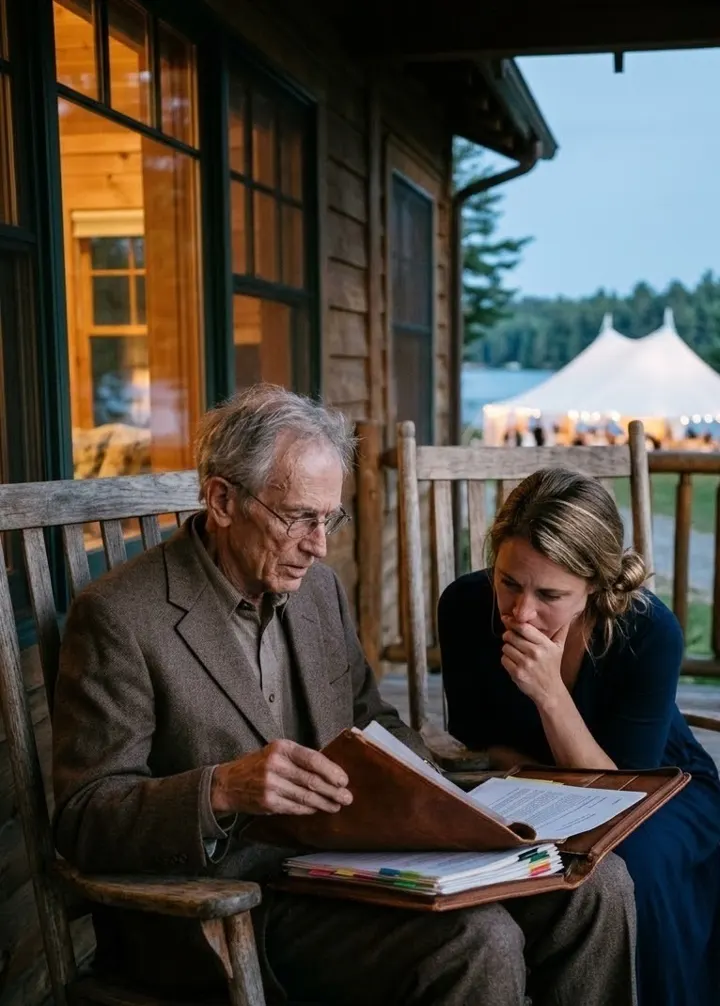
Everett Bell didn't want to talk by the boathouse.
"Sound carries over water," he said, tapping his hearing aid. "I should know. I hear about a third of what's said to me and all of what's said behind me."
So we walked up to the lodge and sat on the far end of the wraparound porch, where the rocking chairs faced the parking lot instead of the lake and nobody from the wedding wanted to be. From there I could see the tent and table fourteen. Owen sat at Everett's place by the kitchen door with a napkin tucked into his father's tie, eating a dinner roll and talking to a waiter.
Everett followed my eyes. "He's all right for the moment."
"He asked me if he stopped being family when his dad died."
Everett closed his eyes briefly. "Walter would have driven his truck through that tent."
"Walter's not here."
"No," he said. "That's why I am."
He opened a thin leather folio on his knees. Inside was a stack of paper, stapled and tabbed, with a yellow sticky note on top in tidy handwriting: L.H. copy.
"Can I ask you what you were told," he said, "about Walter's estate?"
I thought back. It wasn't hard. That whole week is burned into me in hot white light: the hospital in Brainerd, the funeral, the luncheon at the church afterward with ham buns and bars and Diane in the center of every room.
"Diane told me Walter left everything to her," I said. "She said that's how it works with spouses. She said he'd set up a college fund for Owen. Twenty-five thousand dollars. Kristen brought the paperwork to the luncheon and I signed it."
"Twenty-five thousand," Everett repeated.
"I was grateful. I wrote Diane a thank-you card."
He made a small sound, not quite a laugh. He turned the folio around so I could read it.
THE WALTER E. HALVORSEN REVOCABLE TRUST, as amended and restated.
He flipped to a tab and put his finger on a paragraph.
"Walter owned one hundred percent of Halvorsen Hardware," he said. "Seven stores. The flagship in Brainerd, the others from St. Cloud up to Bemidji. When he died, the trust divided the company's shares into three equal parts, one for each of his children."
"Michael was already gone."
"Yes. And Walter planned for that. Michael's third did not go back to the family. It went into a separate trust for Michael's child." He looked at me over his glasses. "Owen owns one third of Halvorsen Hardware, Mrs. Halvorsen. He has for two years. I'm the trustee of his share until he turns twenty-five."
I said nothing. A car door slammed in the parking lot. Somebody laughed in the tent.
"That can't be right," I finally said. "I would know."
"You'd know if you'd read the notice I sent you in August of that year. Did you?"
The drawer under the microwave. The thick envelope with the law firm's return address. I had opened it, seen pages of words like hereinafter and per stirpes, seen Diane's name at the top, and thought: She already told me what it says.
"I skimmed it," I said. My face was hot. "Diane had explained it. I thought it was a copy for my records."
"Diane received the same notice," Everett said gently. "So did Kristen and Tyler. I explained it to all three of them in my office, with a pot of very bad coffee. Diane knew exactly what Owen inherited. So did Kristen."
I stared at Owen across the lawn. He was showing the waiter something on the tablecloth, probably a knot. A boy who owned a third of seven hardware stores, eating a dinner roll at the kitchen door because his grandmother wouldn't let him stand under a willow tree.
"How much is a third worth?" I asked. I hated that it was my first question, but it was.
"The company was appraised at a little over fourteen million dollars at Walter's death." He let that sit. "Owen's share isn't money you can spend. It's shares in a family business, held in trust. But it's real, and it's his, and it's a vote. One of three."
I thought about the twenty-five thousand dollars. The thank-you card. My careful handwriting. We are so grateful for Walter's generosity, and yours.
"Why would she lie to me?"
"I think you know the answer to that better than I do," Everett said. "But I can tell you why I'm here."
He flipped to another tab. Article Nine had its own heading in capital letters.
FAMILY INCLUSION.
"Walter rewrote his trust the winter after Michael died," Everett said. "He sat in my office for three afternoons. He knew Diane. He loved her for forty-four years, and he knew her. He was afraid that once he was gone, Michael's boy would be pushed out of the family a little at a time. Holidays. Birthdays. Photographs." He paused on that word. "Walter was particular about photographs."
"Why?"
"That's his to tell you. I believe he left a way to do it." Everett cleared his throat. "Article Nine says this. For twenty-four months after Walter's death, the shares and income for Diane, Kristen and Tyler are held back. They get an allowance. The final distribution waits. At the end of the twenty-four months, the trustee, which is me, makes a determination."
"About what?"
"About whether any of them materially and intentionally excluded any of Walter's grandchildren from the family. Or contested a grandchild's share." He tapped the page. "If I find that someone did, that person's held-back share doesn't go to them. It goes into a trust for all of Walter's grandchildren. Equally. Mason and Lily included."
I read the paragraph myself. Then I read it again, slower. The language was dry and careful, but under it I could hear Walter. The tackle box. The donuts. Square and patient.
"When are the twenty-four months up?"
"Walter died on June twenty-seventh, two years ago." Everett closed the folio. "Seven days from now."
Seven days.
"Do they know?" I asked. "About this part?"
"They were told. They signed acknowledgments. Whether they believed it is another question." He looked toward the willow tree, where the photographer was now shooting the bridal party. "I think they read Article Nine as an old man's sentiment. I think they believed I'd never enforce it. And I think they believed you'd never hear of it."
"Would you? Enforce it?"
He took a long time answering.
"I don't make findings from feelings," he said. "I need evidence. Dates, documents, witnesses. A pattern. That's what Walter asked of me, and it's what a judge would ask if anyone challenged me." He nodded at my phone. "So I'm asking you. What happened tonight, keep it. And when you get home, think hard about the last two years. Every missed holiday. Every invitation that didn't come."
I already knew. I'd been not counting for two years. The count was right there, waiting.
"Okay," I said.
"One more thing." Everett reached into his jacket and handed me a business card, soft at the corners. "Don't confront them tonight. Not at Tyler's wedding. Let them think it went the way they wanted."
I didn't confront anybody.
I went back into the reception and took pictures like a guest. The seating chart on its easel, with Owen's name missing from every table. The family table with its anchor and its flower. The two Reserved cards, still on empty chairs. I asked a waiter what they were for. He checked a list.
"Those were for the bride's aunt and uncle," he said. "They canceled last week."
Two empty seats at the family table. All night.
I took a picture of those too.
At nine-thirty, when the dancing started and the speeches were over, I left Owen at table fourteen. Everett was sitting next to him now, on a folding chair from the stack. They were drawing the lake on a napkin, depth lines and all. I went to find the restroom.
The hallway inside the lodge was long and dim, with wood-paneled walls and old photographs of fishermen holding up enormous pike. The carpet swallowed my footsteps. I was halfway down it when I heard Kristen's voice coming from an alcove near the coat room.
She was on the phone. She sounded different from the hostess voice. Faster. Flatter.
"No, I told you, it's done. Monday. We file Monday."
A pause.
"Because Everett won't vote for the sale, Scott. He'll never vote Owen's shares for the sale at that number. We need a different trustee before Gordon's people close on the thirtieth. That's the whole point."
I stopped walking. I flattened myself against the paneling under a picture of a man with a sturgeon.
"No, she won't fight it. She doesn't even know what it is." Kristen laughed, a short dry sound. "Leah already signed the consent. At the funeral luncheon. I put it in the stack with the college fund forms and she signed every page. She thinks she was signing for twenty-five grand."
My hand went to my mouth.
"And Mom wants the kid out of the pictures," Kristen went on. "She says she can't look at him. Fine by me. The fewer photos of Michael's son next to the family when the Pryces see the album, the fewer questions about whose shares are whose."
Another pause.
"Yes. Monday. I'll see you in the room."
I heard the click of heels on the floor of the alcove and I moved before I could think. I pushed through the restroom door and locked myself in a stall and stood there, shaking, my phone in my hand.
I opened the voice memo app.
All night I'd been murmuring notes into it the way I chart a patient's gums, table nineteen, no card, two reserved seats empty. In the hallway, when I heard Kristen say Monday, my thumb had found the red button before I'd decided anything.
The recording was two minutes and nine seconds long, and Kristen was on it.