The notice stayed under my windshield wiper until the sun went down.
I couldn't make myself touch it while the neighbors were still out on their porches.
Marcus Hale had gone back inside with his phone. The Brandt Groundworks trailer had pulled away with Tommy's ramp stacked on it like firewood. Kyle Brandt had climbed into his white pickup and given me a little two-finger wave from the wheel, the kind you give a neighbor on a Sunday.
When it was dark I went out and pulled the paper free.
It was damp from the evening air. Notice of Lien and Intent to Foreclose. Larkspur Court Homeowners Association. Amount due: $11,400.00. It was signed by an attorney named Brent Saylor, with an office address in Decatur.
I read it standing next to the car.
Then I read it again at the kitchen table, under the good light.
Then I went to the hall closet.
Our house is a split-level. The front door opens onto a landing, and you go up six steps to the kitchen or down six to the hallway where the laundry room is, and the closet, and the door to the basement apartment.
That closet was Tommy's joke for thirty-one years.
"Glo," he used to say, "the IRS does not want your gum receipts."
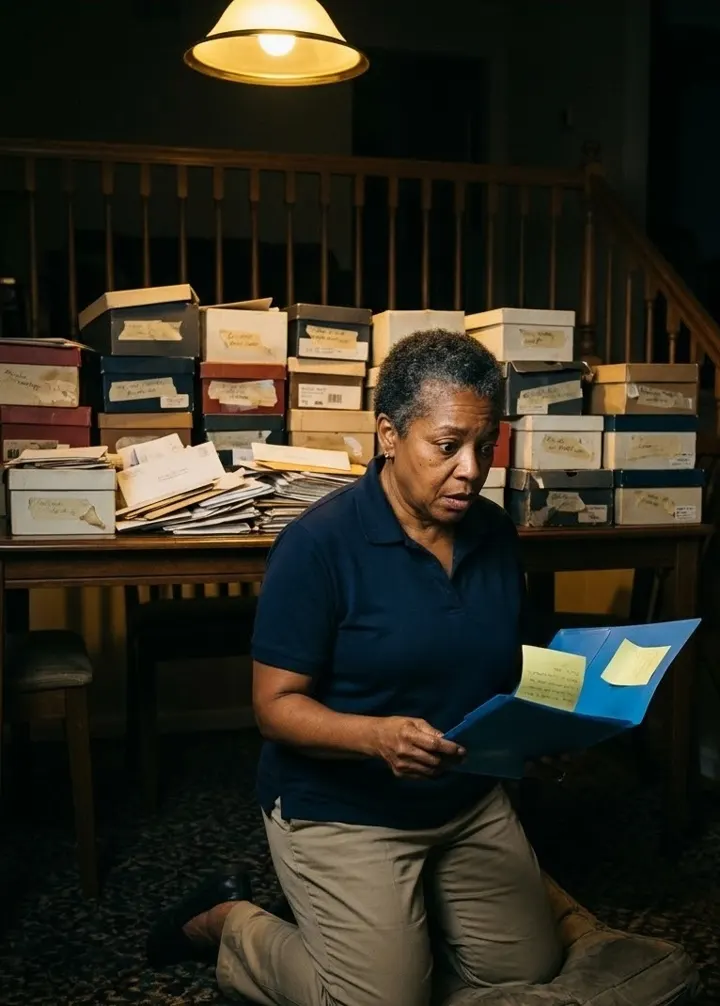
I kept them anyway. Every receipt, every warranty card, every letter from the county. One shoebox per year, and inside each shoebox, envelopes by category. HOUSE. CAR. MEDICAL. BUS UNION. I wrote the labels on masking tape in black marker.
When Tommy got sick he stopped teasing me about it.
He started using the boxes himself.
I got the step stool and started pulling them down.
There were forty-one boxes. I counted later. Some were from shoe stores that don't exist anymore. Some were from boots Tommy wore out on job sites. The oldest one had a rubber band around it that crumbled when I touched it.
My left knee does not like step stools.
I didn't tell it that I cared.
By the time I had the top shelf cleared, there were boxes on the hallway carpet, boxes on the dryer, and boxes stacked against Simone's door.
The door opened about two inches.
"Mrs. Mendes?"
"I'm sorry, honey. I'm being loud."
Simone Achebe had been renting the basement for eight months. She paid on the first of every month with a paper check, in an envelope with my name printed neatly on the front. She kept her car washed and her music low. When I asked her once what she did, she said, "I work for the state," and smiled like that was the whole answer.
I didn't push. I was raised not to.
She opened the door the rest of the way. She had on a gray sweatshirt and reading glasses, and she had a pen behind her ear like she'd been interrupted in the middle of something.
She looked at the boxes. Then she looked at my face.
"I saw what happened this afternoon," she said. "I was parking."
"Most of the street saw it."
"Are you taking these upstairs?"
"I was going to."
"Let me carry them," she said. "You go ahead of me and tell me where they go."
I said no twice. She just picked up the first stack and waited at the bottom of the steps until I went up in front of her.
We made a wall of them along the dining room table. Simone carried. I sorted. She set every box down with the label facing out, so I didn't have to turn any of them around.
"You file by year and then by category," she said, studying the tape on 2017.
"My husband thought I was crazy."
"Most offices I've seen don't do it that well."
I wanted to ask her which offices. I didn't.
When the last box was up, she stood in the doorway between the dining room and the kitchen and nodded at the notice lying on the table.
"May I?"
I pushed it toward her.
She read it the way I read bus schedules, the first time a route changes. Slowly, top to bottom, her finger moving down the margin.
"It says the fines started accruing in August," she said. "Did you get a violation letter in August?"
"I didn't get anything."
"Nothing in the mail? Nothing taped to the door?"
"Nothing. I'd have put it in a box."
She almost smiled at that. Then she set the paper down exactly where it had been.
"That's worth remembering," she said. "I'll let you work. Knock on the floor if you need hands."
She went back downstairs. I heard her door shut and the lock turn.
My phone rang before I had the lid off the first box.
It was Ray.
My son lives in Charlotte with his wife and my two grandbabies. He calls me every Sunday at seven, so a Tuesday call at nine-thirty meant somebody had told him.
"Mom. Are you okay?"
"Who called you?"
"Nobody called me. Somebody posted a video. Danielle's cousin is in some Atlanta neighborhood page. Mom, they're laughing in the comments. There's a guy with a crying-laughing face under it."
Marcus.
I closed my eyes.
"It's a misunderstanding," I said. "Your father got that ramp approved. I watched him do it."
"Okay. Okay. But they're saying lien. Is there a lien?"
I told him about the $11,400.
I told him about the thirty days.
He was quiet for so long I thought the call had dropped.
"Mom," he said finally, "sell the house."
"Raymond."
"I'm serious. Houses on your street are going for three-ninety, four hundred. You pay off their eleven grand at closing and walk away with the rest. You come up here. There's a ranch house two streets over from us. One floor. No steps for that knee."
"My knee is fine."
"Your knee is not fine. I watched you go down the stairs at Christmas sideways."
I didn't answer that.
"These people want a fight," he said. "You don't have to give them one. Dad wouldn't want you fighting a homeowners' association over some boards."
That made me angrier than anything Kyle Brandt had said on my lawn.
"Your father," I said, "spent two months building those boards with one good hand. He called the county for a permit. He went to the board before he cut a single piece of wood, because he said, 'Glo, I'm not giving these people a reason.' He got it in writing, Ray. He wanted it in writing."
"Then find the writing."
"That's what I'm doing."
He sighed the way his father used to, a long sigh through his nose.
"Call me tomorrow," he said. "Promise."
"I promise."
"And think about the ranch house."
I hung up without promising that.
I started with 2019.
That box was bigger than the others because it was a bad year. The stroke was in February. The hospital bills alone filled two envelopes. There was a whole envelope of rehab appointments, and another one for the medical supply company where we rented his walker and then his wheelchair.
The ramp folder was in the back.
It was a blue plastic folder with an elastic band, the kind you get at the drugstore. On the front, in Tommy's block letters, it said RAMP 2019.
He wrote everything in block letters after the stroke. His cursive went shaky, and he hated it, so he printed everything in capitals like a man filling out a form.
I sat down to open it.
The first thing inside was the lumber receipt from the builder's supply on Memorial Drive. Thirty-two cedar deck boards. Pressure-treated posts. Joist hangers. Two boxes of coated screws. $1,914.37, paid in cash, because Tommy didn't trust credit cards for "real work."
Behind that was the DeKalb County residential permit, with the inspector's initials and a stamp from the final inspection in June.
Behind that was a quote from a welding shop in Tucker for the metal handrails, because Tommy said he could do wood one-handed but he wasn't fool enough to try to weld. $860. Paid by check. I had the carbon copy clipped right to it.
There was a sketch on graph paper. The slope measured out in his printing. ONE INCH RISE PER FOOT. 1:12. ADA.
There was a sticky note in the front pocket of the folder, yellow, curling at the edges.
APPROVAL LETTER: KEEP ON TOP.
I looked at the top of the stack.
The lumber receipt was on top.
I went through the folder again, slower. Receipt. Permit. Welding quote. Sketch. Two photos of Tommy in his wheelchair at the bottom of the finished ramp, giving a thumbs-up with his good hand.
There was no letter.
I remembered that letter. It was one page on the association's letterhead, the old green logo with the little tree. The letter said the board had reviewed the application for a wheelchair-accessible ramp at 14 Larkspur Court and approved it as submitted. It was signed at the bottom by Loretta Pruitt, the president back then, in big loopy handwriting, with a second signature beside hers.
Tommy kept it on the refrigerator for a week, under a magnet shaped like a pineapple.
Then he put it in the folder. On top. And wrote the sticky note so I wouldn't move it.
I emptied the whole 2019 box onto the table.
I checked every envelope. Medical. House. Car. Bus union. I checked 2018 in case I'd misfiled it. I checked 2020. I checked the drawer under the phone where I keep stamps and rubber bands.
At midnight I was on my knees on the dining room floor with my bad knee on a couch cushion, running my hand along the bottom of the closet shelf like the letter might have slid down behind it.
It was the only page that mattered.
And it was the only page missing.
I sat back on my heels and held the blue folder in my lap.
Somebody had opened this folder besides me and Tommy. Somebody who knew which page to take.
I made myself think about who had touched it.
Ray had never seen it. Simone had moved in long after. I had never mailed it anywhere. Never scanned it, never copied it, never given it to anyone.
Except once.
Last spring. April, because the azaleas were out along the walk. A man in a fleece vest came up my front steps, past the ramp, with a smile on his face and a coffee in his hand.
He said he was new on the board. He said they were going through old files because the management company had lost half of them.
"We're updating the architectural records, neighbor," he said. "Anybody with a modification on file, we just want a copy for our records. Make sure everybody's protected."
I was flattered somebody was finally organized.
I went to the hall closet and brought him the blue folder.
He brought it back eight days later and thanked me for being such a good neighbor.
I never opened it to check. Why would I?
Then I remembered who had borrowed that folder last spring, smiling on my porch about "updating the architectural records."
It was Kyle.