I didn't sleep after the reception.
I lay on top of the covers in my old bedroom with the deed copy face down on the nightstand.
Every time I closed my eyes, I saw the date.
April 14.
My stomach kept turning it over like a coin, and my head kept refusing to tell me what was on the other side.
At 5:52 a.m., my phone buzzed.
Then it buzzed again, and after that it didn't stop.
The first text was from Tasha, a friend from nursing school who works nights at the hospital on Grant Road.
"Have you seen what your sister posted? Call me before you read the comments."
The second was from a number I didn't recognize.
"Shameful."
The third was a link.
I sat up and opened Whitney's page.
My sister has four hundred and ten thousand followers.
She sells collagen powder and linen throw pillows and a morning routine that starts at 4:45 with something she calls "intention journaling."
The video was forty-seven seconds long.
It opened on me under Mom's lemon tree, still holding the pitcher of sweet tea, my face folded in on itself the way faces do when you've stopped being able to control them.
You couldn't see the envelope.
You couldn't see Craig.
He'd stepped out of the frame before she started filming, and the angle cut him off at the shoulder.
Over the top of my crying, Whitney's voice came in soft and low, the voice she uses for sponsored meditation clips.
"Grief shows up differently for everyone, you guys. My sister has been carrying so much. We're just trying to hold space for her right now."
The caption said, "Holding space for my sister while she processes," with a little white heart at the end.
It had 1.3 million views.
It had been up for nine hours.
I told myself to close the app.
I read the comments instead.
"Wait so she lived in her mom's house for FOUR YEARS rent free and now she's sobbing because she has to move out? lol."
"Freeloader energy."
"My aunt did this to my grandpa. 'Caregiver.' Took his social security and his car."
"Whitney you are so graceful through all of this."
"The brother looks so patient honestly. You can see him walk away to give her privacy."
"Some people get comfortable living off their parents and think they're owed the house."
Someone had written my full name.
Someone else had replied with a screenshot of my profile from the home care agency's website, the one with my photo in navy scrubs and the line "Renee has 11 years of experience in dementia and palliative care."
Underneath it, a woman in Ohio had written, "Experience is right. She knew exactly what she was doing."
I put the phone face down on the bed next to me, the same way I'd put down the deed.
Then I picked it back up and called Whitney.
It rang four times and went to voicemail.
"Hi, it's Whit! Leave me some good energy!"
I hung up and texted her.
"Please take it down. People are saying I stole from Mom. They found where I work."
She answered at 7:40.
"It's honestly not about you, it's about normalizing grief. The engagement is super positive overall. Don't make this weird. Love you."
A minute later, a second text came in, from Craig.
"Truck pickup Sunday 8 a.m. Don't make me call the sheriff."
I typed, "I'm sorry, I just need more time to figure out—"
Then I deleted it.
I didn't know what I was apologizing for.
That's been a habit of mine since I was about nine.
I got dressed, because Thursdays I have Mr. Pruitt at ten, and Mr. Pruitt doesn't care whose mother died.
Walt Pruitt is eighty-one and has Parkinson's.
I'd been bathing him and doing his meds three mornings a week for two years.
He calls me Sergeant because I make him finish his oatmeal.
I was in the car with the keys in the ignition when the agency called.
It was Gloria, the scheduler at Sonoran Home Care.
She has run that office for twenty years and has never once sounded nervous on the phone.
She sounded nervous.
"Renee, honey. I'm so sorry about your mom."
"Thank you. I'm on my way to the Pruitts'."
There was a pause.
"That's why I'm calling. Bethany Pruitt phoned at seven. She saw a video."
My hands were still on the wheel.
"She says she doesn't want someone who takes advantage of old people alone with her father," Gloria said. "Her words. I told her it was garbage. I told her I've known you eleven years."
"I understand."
"It's the client's right to request a change. I have to honor it."
"I understand," I said again. "I'm sorry for the trouble."
"Stop apologizing, mija. You didn't do anything."
She told me she'd try to find me other hours.
She also told me, without saying it directly, that she had nothing open until the middle of next month.
Mr. Pruitt was thirty-one hours a week.
At $19.50 an hour, that was most of what I made.
I turned off the car and sat in Mom's driveway for a long time.
Two doors down, Mrs. Okafor was watering her bougainvillea.
She waved at me, and then she looked down at the phone in her other hand, and then she stopped waving.
I went back inside.
The kitchen still smelled like the reception.
The fridge was full of foil pans with names written on masking tape: Okafor, Delgado, Lindqvist, the church ladies from St. Ambrose.
Everyone who brought food yesterday knew who had been here at three in the morning.
None of them had four hundred thousand followers.
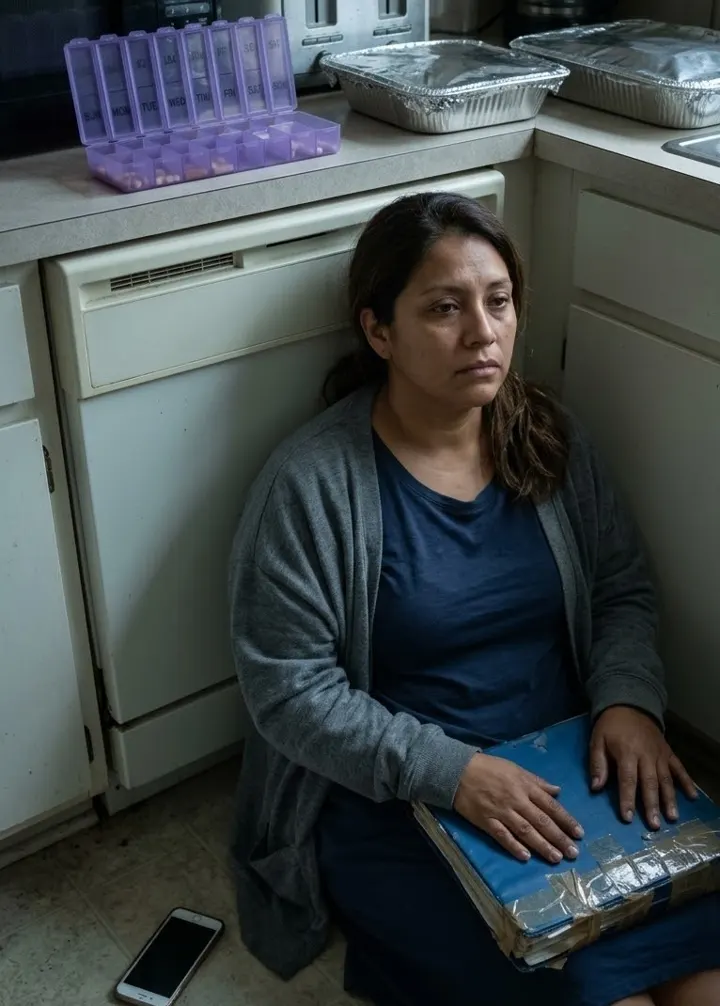
Mom's pill organizer was still on the counter by the coffee maker, the big kind with four slots for every day.
Thursday's evening slot was full.
She died Monday.
I'd filled it out of habit on Sunday night.
I opened the hall closet and took down the binder.
It's a blue three-inch binder with a cracked spine, held together on one corner with packing tape.
On the front I'd written "MOM" in black marker the first week I moved back in, back when I still thought I'd only need one binder.
Inside are tabs for every month of the last four years.
Every visit summary from the neurologist.
Every medication log, with times and doses and my initials.
Every fall, every bruise, every urinary infection, every night she woke up and tried to walk to the elementary school where she used to run the cafeteria.
I kept it because that's what I do at work.
If it isn't written down, it didn't happen.
That's the first thing they teach you.
I sat down on the kitchen floor with my back against the dishwasher and the binder on my knees.
The linoleum was cold through my jeans.
I put my hand flat on the cover.
I couldn't open it.
I knew exactly what was in there, and that was the problem.
Opening it meant going back into every one of those nights.
The night she threw her dinner plate at me because she thought I was a stranger.
The night she cried for an hour because she couldn't find Dad, who'd been gone since 2014.
The morning she held my face in both hands and said, clear as a bell, "You're the one who stays."
And somewhere in the middle of it, under the tab marked APRIL, was whatever my stomach had been trying to tell me since yesterday.
I sat there for most of the morning.
My phone kept lighting up on the floor beside me.
New followers on accounts I hadn't used in years.
A message request that said, "Hope you enjoy the truck, leech."
At 11:30, the phone rang with a number I knew.
Dee Whitfield.
Dee was from hospice.
For the last eight months of Mom's life, every Tuesday at two o'clock, a small woman in sensible shoes and a cardigan, even in July, would knock on the screen door with a crossword book under her arm.
She'd sit with Mom for two hours so I could sleep or shower or sit in the car and cry where nobody could hear me.
She read the newspaper out loud.
She let Mom correct her pronunciation of words she was pronouncing perfectly.
She never talked about herself.
I knew she was a widow, that she had a granddaughter at the university, and that she took her coffee black.
At the reception, she'd spent most of the afternoon at my sink, washing dishes nobody had asked her to wash.
I hadn't seen her leave.
She'd left a card on the fridge, under the magnet shaped like a chili pepper.
"Call if you need anything. I mean anything. —D."
I answered.
"Renee." Her voice was calm and unhurried, the same as always. "My granddaughter showed me a video this morning. I'm calling to ask if you've eaten."
I opened my mouth to say I was fine.
What came out was, "They canceled my shifts."
I told her everything.
The envelope.
The truck.
Mr. Pruitt and his daughter and the thirty-one hours.
I apologized three times for taking up her morning.
She didn't interrupt once.
When I finished, she asked, "What exactly did your brother show you?"
"A deed. A quitclaim deed. It says Mom signed the house over to him."
"Dated when?"
"April 14. Last year."
"Notarized?"
"There's a stamp. And it says it was recorded with the county."
She was quiet for a moment.
I could hear a clock ticking somewhere in her house.
"Renee, I want you to think carefully before you answer this," she said. "In April of last year, could your mother balance her own checkbook?"
I laughed, and it came out wrong.
"Dee, in April of last year there were days she couldn't figure out a spoon."
"I thought so."
Another pause.
"I've never told you this," she said. "It didn't seem to matter on Tuesdays, and your mother liked me better as the lady with the crossword."
"Told me what?"
"Before I started volunteering with hospice, I spent twenty-two years as a judge. Pima County Superior Court. I sat on the probate bench."
I stared at the pill organizer on the counter.
"Probate," I repeated.
"Wills, estates, guardianships," she said. "And deeds signed by people who had no business signing anything."
I didn't say anything.
I couldn't.
"Renee. Did you keep records while you cared for her?"
I looked down at the blue binder on my knees, at the cracked spine and the packing tape and my own handwriting on the front.
"Every day," I said. "For four years."
She let out a slow breath on the other end of the line, the way you do when a long day finally starts going your way.
Then she said, "Bring me everything you kept, honey. And don't move a single box."