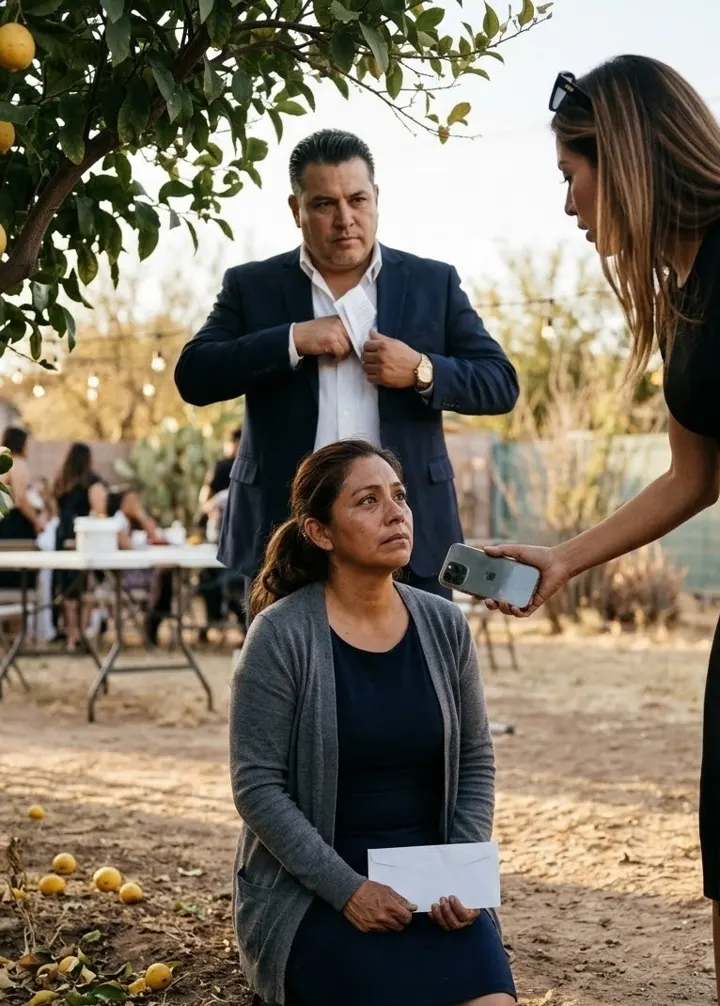
Dee Whitfield lived eleven minutes from my mother's house, in a brick bungalow with a mesquite tree and a porch swing that needed oil.
I knew it was eleven minutes because I sat in the driveway for six more before I could make myself get out of the car.
The blue binder was on the passenger seat.
Three inches thick, with a cracked spine and a coffee ring on the cover from a night in 2021 I didn't remember.
Beside it was a grocery bag with the deed copy, the moving-truck receipt, and the folded program from the funeral.
My phone had forty-one new notifications.
I turned it face down and left it on the seat.
Dee opened the door before I knocked.
She was wearing the same thing she always wore on Tuesdays at Mom's: pressed slacks, a cardigan, and the sensible leather shoes Mom used to point at and call "the good shoes."
"You came," she said.
"You told me not to move a single box," I said. "I didn't know what else to do."
"That's the right answer, honey. Come in."
Her kitchen smelled like coffee and lemon cleaner.
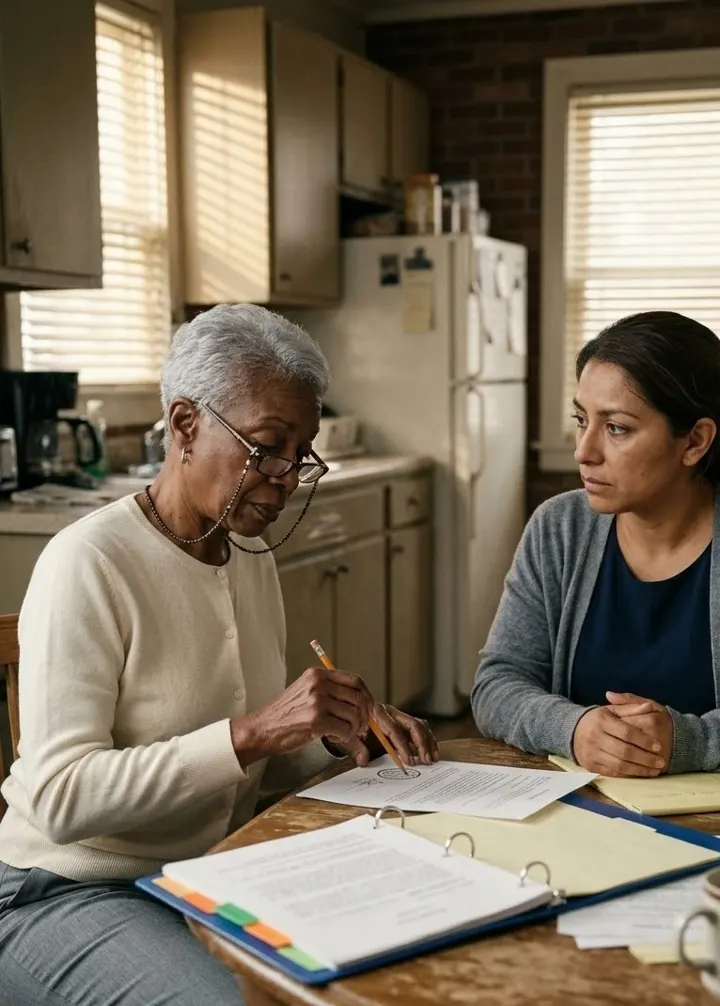
There was a yellow legal pad on the table, two sharpened pencils, and a pair of reading glasses folded on top.
She poured me a cup without asking how I took it.
Then she put in exactly the right amount of milk, because she'd watched me make my own coffee in Mom's kitchen thirty or forty Tuesdays in a row.
I started apologizing as soon as I sat down.
For taking up her time, for the video, and for crying on the phone.
She held up one hand.
"Renee. You spent four years apologizing to a disease. You don't have to do it to me."
I shut my mouth.
She slid the binder across the table and opened it to the first page.
I had made a cover sheet back in the beginning, because that's what we do at work.
CASTILLO, JUNE M. DOB 3/9/1948. DX: ALZHEIMER'S DISEASE, MODERATE. ALLERGIES: SULFA, SHELLFISH.
Under it, in my handwriting, was a list of every doctor, every pharmacy, and every phone number.
Dee put on her reading glasses and picked up a pencil.
She didn't skim.
I've watched a lot of people read a lot of charts.
Doctors skim, family members skim, and insurance reviewers skim so fast you can hear the pages complain.
Dee read every line.
She read the medication logs, the blood pressure readings, and the notes I wrote at 3 a.m. when Mom was trying to leave for a shift at a cafeteria job she'd retired from in 2010.
Sometimes she made a small tick in the margin of her legal pad.
Sometimes she turned back two pages and compared something.
Once, she smiled at an entry, and I leaned over to see which one.
October 2022. "Mom told the pharmacist he had a face like a disappointed potato. Pharmacist laughed. Mom very proud."
"She told me that one too," Dee said. "Twice. It got better the second time."
I laughed, and it came out wet.
It took her almost an hour to get through the first year.
Then she put the pencil down and looked at me over her glasses.
"I'm going to ask you some boring questions," she said. "Answer them as plainly as you can. Don't guess. If you don't know, say you don't know."
"Okay."
"Who visited your mother in the last four years? Family, I mean."
"Craig came twice," I said. "Christmas of 2021, and the summer after. He stayed about two hours each time."
"What did he talk about?"
"The house." My face got hot. "Whether it was paid off and whether Mom had a will. He said he was just being responsible."
She made a tick.
"Your sister?"
"Whitney came more. Maybe five or six times. She'd bring flowers and take pictures with Mom on the patio." I paused. "She usually left before dinner."
"Did anyone take your mother out of the house without you?"
I opened my mouth and closed it.
Something was there, at the edge, like a word on the tip of your tongue.
"I don't know," I said. "I'd have to look."
"Good. That's the right answer too." She wrote something. "Now, who handled her mail?"
That one I knew.
"I did, mostly. Until the fall before last."
"What happened that fall?"
"Craig called. He said I had enough on my plate and he'd take over the bills. Utilities, property tax, the credit union statements." I swallowed. "He set up a forwarding thing for anything financial. It went to his dealership in Phoenix."
Dee's pencil stopped.
"And you agreed?"
"I was working doubles. Mom had stopped sleeping. He was being nice for once." I heard how it sounded. "I thought he was finally helping."
"How long did it go to Phoenix?"
"Until February, I think. Then the water got shut off for a day because nobody paid it, and I took it all back."
She wrote that down too.
Then she took off her glasses and folded them, and her voice changed.
It was still gentle, but there was something underneath it now, like a steel beam under a nice floor.
"Let me tell you what a deed is," she said. "Strip away the fancy language and it's a person saying, 'This thing is mine, and I am choosing to give it to you.'"
I nodded.
"For that to mean anything, the person has to understand three things at the moment they sign. They have to know what they own. They have to know what they're giving away, and to whom. And they have to understand what happens after, which is that it's gone."
She tapped the binder.
"A good notary is supposed to check. A good lawyer is supposed to check. When nobody checks, the law still asks the question afterward. Did she understand, on that day, at that table, with that pen in her hand?"
"She didn't," I said. "She couldn't have."
"I believe you. A judge won't take my word or yours." She turned the binder toward me. "A judge will take paper. So go to April and show me."
My hands were shaking when I found the tab.
I had color-coded the months, because I am that kind of person.
March was green, April was orange.
But the first thing I found wasn't in April.
It was the last page of March, in a plastic sleeve, because I had made a copy and filed it where it belonged.
A letter on clinic letterhead.
DESERT SAGE NEUROLOGY ASSOCIATES. Dr. Anand Mehra, MD.
Dated March 28 of last year.
I'd forgotten it existed.
I'd needed it for Social Security, to become Mom's representative payee after she started giving her debit card number to anyone who called and said they were from the bank.
I read it out loud, because I didn't trust myself to read it silently.
"'Mrs. Castillo has a progressive neurocognitive disorder consistent with Alzheimer's disease, moderate to severe stage. Her most recent cognitive assessment score was eleven out of thirty. In my professional opinion, she lacks the capacity to manage her finances or to make legal decisions, including entering into contracts or transferring property. This condition is not expected to improve.'"
The kitchen was very quiet.
Dee held out her hand, and I gave her the sleeve.
She read it twice.
"Seventeen days," she said. "Seventeen days before the date on that deed, her own neurologist put in writing that she couldn't do the exact thing your brother says she did."
"Does Craig know about this letter?"
"That," Dee said, "is an excellent question for later. Keep going."
I turned the page into orange.
April 1. April 3. A fall in the bathroom, no injury. April 6. April 9.
April 11 was where it started.
"Mom more confused than baseline. Urine dark, strong odor. Temp 99.8. Called Dr. Okonjo's on-call."
April 12. "Urgent care. Dx UTI. Started on antibiotic, first dose 4:15 p.m. Doctor says delirium likely for several days. Do not leave alone."
Then April 14.
I knew it was April 14 before I read the date, because my handwriting looked different.
It was smaller and pressed hard into the paper.
"6:40 a.m. Found Mom standing at bathroom mirror. Asked me who the old woman was and why she was in our house. Told her it was her. She said, 'No, honey, I'm forty.' Cried for twenty minutes. Temp 100.4. Gave Tylenol and antibiotic dose #4. Would not eat. Called me Rosa twice."
Rosa was her sister.
Rosa died in 1997.
I stopped reading.
Dee waited and didn't rush me.
"There's more," she said quietly. "I can see it on the page."
I looked down.
"7:45 a.m. Leaving for double at the Hendricks house. Covered."
The next entry was at 11:20 that night.
"Home. Mom asleep in the recliner with her shoes on. Wouldn't let me take them off. Kept saying she had to sign for the lunch delivery."
I read it again, then a third time.
I didn't remember writing it, and I couldn't remember who had covered.
The gap in the middle of the page looked like a hole somebody had cut out with scissors.
"Renee," Dee said.
"I don't remember who was with her," I said. "I always write it down. I always write down who covered."
"You were working a double during the worst week of a delirium. You wrote down what mattered most. Her temperature, her medicine, and what she said." She set her hand flat on the page. "This is exactly what a judge wants. You wrote it that morning, with no idea it would ever matter."
She pulled the grocery bag toward her and took out the deed copy.
I'd looked at it a hundred times since the reception.
The county recording number. The legal description of the lot. Mom's signature, wobbling down and to the right like it was trying to slide off the line.
And at the bottom, a round black stamp I had stared at without really reading.
LYLE R. BRANDT. NOTARY PUBLIC. MARICOPA COUNTY, ARIZONA.
Under it was a line in neat, slanted handwriting.
"Acknowledged before me on this 14th day of April."
I had read the name the night of the funeral and felt nothing.
It was just another stranger's name on another piece of paper.
Dee put her reading glasses back on.
She looked at my log, at the letter from Dr. Mehra, and at the stamp.
Then she took her pencil, eraser end down, and tapped the black circle once, the way she used to tap the rummy table at Mom's when it was her turn.
"Maricopa County," she said. "Your mother lived in Pima County. And on April 14, by your own log, she couldn't recognize her own face in a mirror."
She looked up at me.
"Who is Lyle Brandt, and why was he working on a Saturday?"